A piping specification can look settled until one line raises a difficult question: “Carbon Steel Pipe, Schedule 40.” In a water utility, process skid, steam branch, or produced-fluid line, that description is often not enough to purchase, fabricate, or approve the material safely. The pipe may fit the nominal size and appear heavy enough, yet still be unsuitable for the temperature, chemical exposure, joining method, or testing basis of the system.
This becomes costly when the gap is discovered after material arrives. A grade intended for ordinary service may be proposed for low-temperature duty. A heavier schedule may be selected to “solve” pressure concerns even though the real limitation is corrosion allowance, weld quality, or flange class. In another common situation, a designer specifies a familiar grade but does not identify whether seamless or welded construction is acceptable. These choices affect more than purchase cost; they influence fabrication time, inspection scope, support loading, flow capacity, and the margin available when operating conditions change.
Matching Carbon Steel Pipe grades and schedules to service conditions is therefore a decision process, not a catalog lookup. Start with the duty, separate material-grade questions from wall-thickness questions, then verify that the selected pipe works with the governing piping code and connected components.
Start with the line’s actual duty, not the nominal pressure alone
Before comparing ASTM, API, or other material designations, collect the conditions that the pipe will experience through its operating life. Design pressure and design temperature are essential, but they are only the beginning. A line that normally carries cool water may need to withstand a steam-out cycle. A hydrocarbon line may see pressure surges during valve closure. An outdoor line can have a minimum metal temperature far below its normal process temperature during shutdown.
A useful first review distinguishes between normal operating conditions, design conditions, occasional conditions, and abnormal but credible events. The material selection should not be based only on the most frequent operating point. If the line has relief scenarios, thermal expansion cases, vacuum conditions, startup heating, cleaning chemicals, or intermittent solids, record them before choosing grade or schedule.
Also identify the fluid clearly. “Water service” can mean treated water, seawater, fire water, produced water, boiler feedwater, or water with cleaning additives. Each has different corrosion and deposition behavior. “Oil service” can include sour fluids, entrained water, abrasive particles, wax, or dissolved gases. Carbon steel may be appropriate in many of these duties, but its suitability depends on the full fluid description and the expected corrosion-control method.
Grade and schedule answer different questions
One of the most persistent selection errors is treating grade and schedule as interchangeable measures of strength. They are related in a design calculation, but they do not mean the same thing.
A pipe grade defines the material specification and its required mechanical and chemical properties. Depending on the specification, it may also define manufacturing route, heat treatment, testing, dimensional limits, and supplementary requirements. Examples frequently encountered in industrial work include ASTM A106 Grade B for seamless carbon steel pipe used in higher-temperature service; ASTM A53 Grade B for certain welded or seamless general-service piping applications; API 5L grades for line pipe applications; and ASTM A333 grades where low-temperature toughness requirements are relevant. The exact specification must be checked rather than inferred from a familiar grade name.
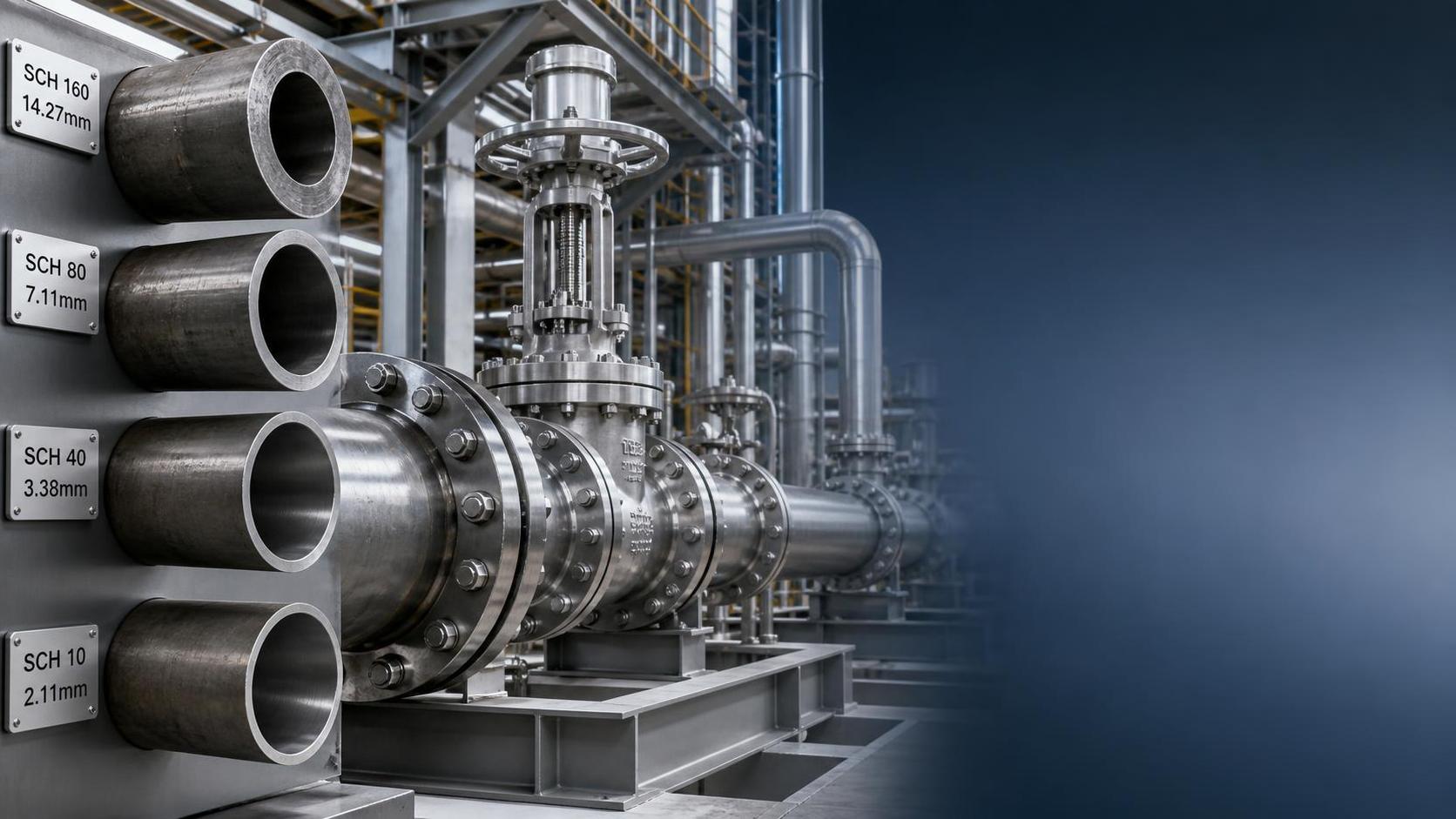
A pipe schedule identifies nominal wall thickness for a given nominal pipe size under a dimensional standard such as ASME B36.10M for welded and seamless wrought steel pipe. Schedule 40, Schedule 80, Standard Weight, Extra Strong, and Double Extra Strong are wall-designation terms. A Schedule 80 pipe has a thicker wall than Schedule 40 at the same nominal size, but the outside diameter generally remains the same. The thicker wall reduces internal diameter, increases weight, and can improve pressure capacity when all other design variables permit.
Schedule is not a universal pressure rating. Allowable pressure depends on outside diameter, actual wall thickness, material allowable stress at design temperature, weld joint factor where applicable, corrosion allowance, mechanical allowances, and the requirements of the governing design code. A pipe marked Schedule 40 cannot be approved for a stated pressure merely because another Schedule 40 line operates at that pressure elsewhere.
Where familiar carbon steel grades tend to fit
Material selection should begin by asking which standard is recognized by the project specification and applicable design code. After that, compare the stated service with the limitations and intended scope of the material standard.
General plant piping and utility lines
For many noncritical utility and process services, ASTM A53 Grade B may be considered where the project allows it and the required construction form is available. It is commonly associated with welded or seamless pipe and is often encountered in general piping applications. Its availability can make it practical for ordinary low- to moderate-demand systems, but availability should not become the selection rationale. Confirm the required end condition, weld type, dimensional standard, coating compatibility, and any project restrictions on electric-resistance-welded pipe.
When the line involves elevated temperature, ASTM A106 Grade B is often reviewed because it is a seamless carbon steel pipe specification intended for high-temperature service. That does not mean it is automatically the correct answer for every hot line. The design temperature still determines the allowable stress used by the piping code, and the system may have additional concerns such as creep-range exposure, cyclic operation, steam quality, or local overheating. Pipe grade alone does not address those concerns.
Transmission and line-pipe duties
API 5L grades are commonly associated with pipeline systems carrying oil, gas, water, and similar fluids. The product specification level, manufacturing method, toughness expectations, sour-service requirements, and project-specific supplementary requirements may all matter. A line-pipe specification should not be casually substituted for a plant-piping material specification, even when nominal dimensions look compatible. Verify code listing, traceability requirements, end preparation, and the intended scope of both standards.
Cold environments and low-temperature exposure
When the minimum design metal temperature falls below the range accepted for ordinary carbon steel under the governing code, low-temperature toughness becomes a primary issue. ASTM A333 material grades are often considered for low-temperature service because the specification addresses impact testing requirements. The correct choice depends on the applicable code, thickness, design temperature, and required impact-test conditions. Do not assume that a heavier schedule fixes brittle-fracture risk; thicker material can require more careful toughness review.
Use schedule selection as a controlled calculation
Once the material is tentatively selected, determine the required wall thickness using the governing piping code. The designer typically evaluates internal pressure with a code equation that incorporates design pressure, outside diameter, allowable stress, weld or quality factor as applicable, and code coefficients. The calculated minimum is then adjusted for corrosion or erosion allowance, thread or groove allowance where relevant, manufacturing tolerance, and any code-required mechanical considerations.
The resulting required thickness should be compared with the minimum available wall, not simply the published nominal wall. Pipe manufacturing tolerance matters. If a selected schedule has a nominal thickness only slightly above the calculated requirement, negative mill tolerance and future material loss can remove the apparent margin. The purchase specification and calculation basis should be consistent on this point.
Consider a line where pressure calculation indicates that Schedule 40 has enough nominal thickness. If the fluid has measurable internal corrosion potential, the line is expected to remain in service for a long period, or inspection access will be difficult, Schedule 40 may no longer be adequate after corrosion allowance and tolerance are considered. Moving to Schedule 80 may be reasonable, but only after checking the consequences: reduced bore, higher pressure drop, heavier supports, different branch reinforcement needs, more demanding welding heat input, and compatibility with valves and fittings.
In small-bore piping, schedule changes can have a particularly large effect on flow area. This is easily overlooked when pipe is selected from a pressure table without revisiting hydraulic calculations. A thick wall can protect pressure integrity while creating unacceptable velocity, pump demand, solids deposition, or cleaning difficulty.
Corrosion allowance is not a substitute for corrosion assessment
Carbon steel performs predictably in many services when corrosion is understood and controlled. It can also lose wall thickness unevenly when conditions promote oxygen ingress, carbon dioxide corrosion, sulfide-related damage, under-deposit attack, stagnant zones, erosion-corrosion, or external moisture retention. A general corrosion allowance is useful only when it reflects a credible corrosion-rate basis and the likely damage mechanism.
Pay attention to locations where the pipe wall may deteriorate faster than the straight-run average: elbows, reducers, control-valve outlets, dead legs, low points, splash zones, supports, insulation interfaces, and buried-to-aboveground transitions. A schedule chosen from a straight-pipe pressure calculation may need additional protection or a different arrangement at these locations.
For external exposure, clarify whether the protection strategy is coating, lining, cathodic protection, drainage improvement, insulation design, corrosion monitoring, or a combination. For internal exposure, consider chemical treatment, oxygen control, fluid velocity limits, pigging, filtration, and inspection access. If the service contains hydrogen sulfide or other sour conditions, material and welding requirements should be reviewed against the project’s applicable sour-service criteria rather than handled through a generic carbon steel note.
A practical review sequence before releasing material
When several acceptable combinations appear possible, a short, documented review helps prevent late substitutions. The following sequence keeps the decisions connected.
- Define the design envelope. Record design pressure, design temperature, minimum metal temperature, fluid composition, phase behavior, velocity range, expected cycling, and upset conditions.
- Identify the governing documents. Confirm the piping design code, project material specification, client requirements, and the material standards permitted for the system.
- Select the material family. Decide whether ordinary carbon steel, low-temperature carbon steel, line pipe, or another material category is appropriate before choosing a wall schedule.
- Calculate the required wall. Include code factors, corrosion or erosion allowance, mill tolerance treatment, and any allowances needed for threads, grooves, or mechanical loading.
- Check fabrication consequences. Review weld procedure compatibility, preheat needs, branch connections, bend requirements, field fit-up, nondestructive examination, and heat-treatment requirements where applicable.
- Recheck the connected items. Pipe schedule must work with fittings, flanges, valves, gaskets, bolting, supports, and insulation. The lowest-rated or least-suitable item can govern the assembly.
- Set procurement controls. Specify grade, schedule, manufacturing method if required, dimensional standard, testing, documentation, marking, end preparation, coating condition, and traceability expectations.
This process is not a replacement for code design. It is a way to make sure the information needed for code design is gathered before a purchase order or fabrication drawing locks in an unsuitable choice.
Details that commonly change the decision
Seamless versus welded construction: The required form depends on the material standard, code rules, service severity, project practice, and inspection requirements. Neither form should be assumed superior in every application. Examine permitted manufacturing routes, weld-joint factors, quality controls, and the intended duty.
Temperature derating: Mechanical properties and code allowable stresses can change with temperature. A grade that is acceptable at ambient conditions may require a different wall thickness at elevated temperature. The same is true at low temperature, where toughness rather than simple tensile strength may control the decision.
External pressure: Vacuum or jacketed systems introduce collapse considerations. Increasing schedule may help, but unsupported length, ovality, stiffening rings, and code equations also matter. Internal-pressure calculations do not demonstrate adequacy under external pressure.
Structural loading: Pipe racks, long unsupported spans, vibration, thermal movement, and occasional loads can make a pressure-adequate wall unsuitable from a mechanical standpoint. Thickening the pipe adds strength in some respects but also adds dead weight. Support design and flexibility analysis should proceed alongside material selection.
Field modification: If future hot taps, welded branches, threading, grooving, or bending are expected, check whether the selected grade and wall are suitable for those operations. A theoretically adequate selection can create avoidable installation constraints.
When a simple specification should be challenged
Pause before accepting a line item that provides only nominal size, “carbon steel,” and schedule. Request clarification when the service temperature is outside normal ambient conditions, when the fluid chemistry is incomplete, when the line is subject to sour exposure, when corrosion allowance is absent, or when a schedule is specified without a design-pressure basis. The same caution applies if fittings and valves are listed to different dimensional or pressure-class assumptions.
A sound Carbon Steel Pipe specification is usually concise, but it is not vague. It identifies a recognized material standard and grade, a schedule or wall thickness, the applicable dimensional standard, permitted manufacturing method where necessary, design basis, corrosion provisions, and documentation requirements. That level of definition gives purchasing and fabrication teams a clear target while leaving no false impression that schedule alone proves service suitability.
The most reliable choice is rarely the heaviest available wall or the most familiar grade. It is the combination that has been checked against pressure, temperature, corrosion, fabrication, hydraulics, and code requirements as one connected system. That approach reduces unnecessary weight and cost while avoiding the much greater risk of specifying pipe that only appears adequate on paper.
Get real-time quotes
Interested? Leave your contact details.