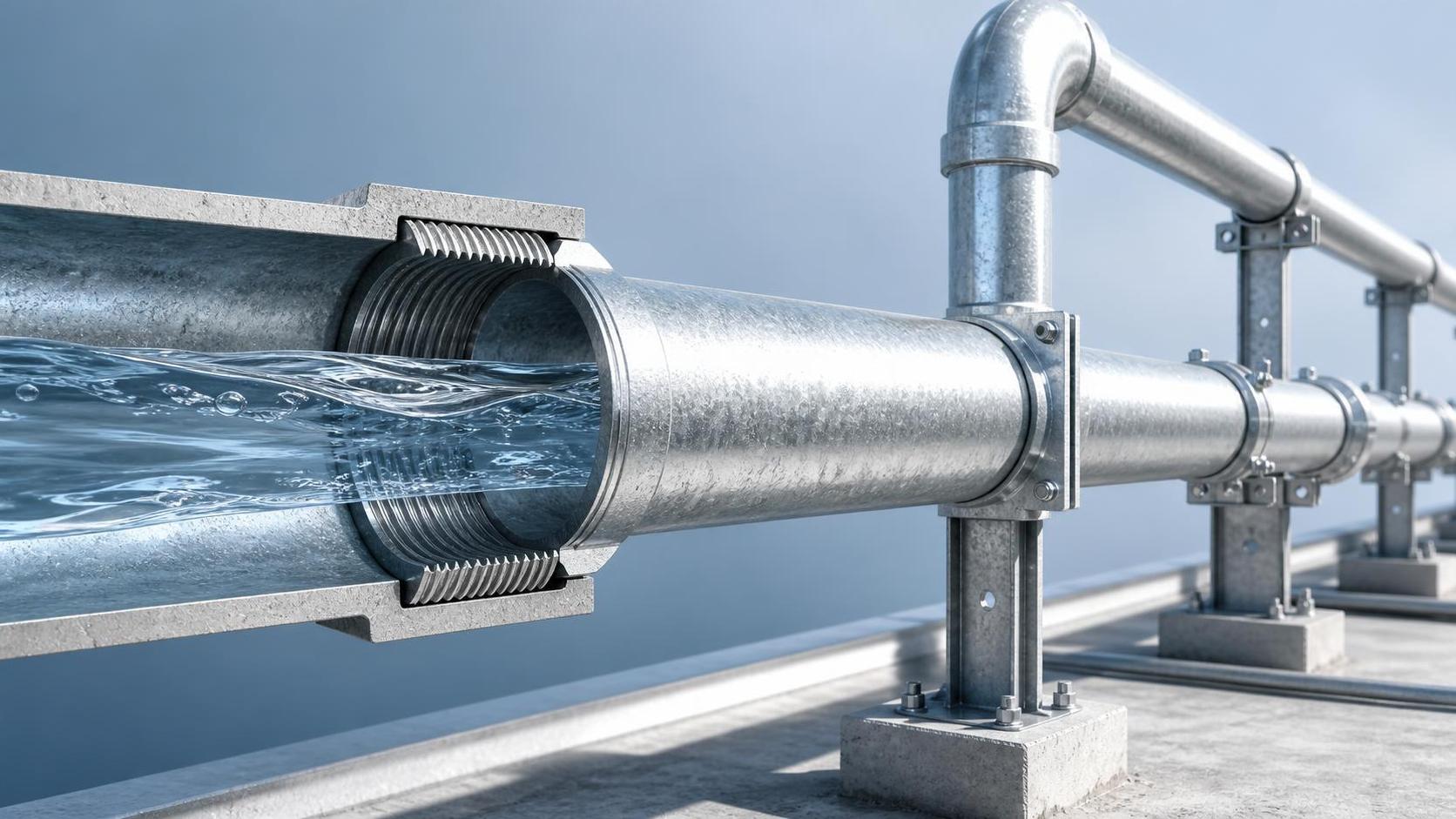
Galvanized steel pipe remains a familiar material in water supply lines, outdoor utility runs, agricultural systems, fencing, and structural applications. Its appeal is straightforward: the steel provides strength, while a zinc coating delays corrosion. But for operators, maintenance teams, and property owners, the useful question is rarely whether galvanized pipe can rust. It can. The practical question is how quickly the pipe will lose reliable service in a specific environment, and what warning signs appear before a leak, blockage, or structural failure occurs.
There is no single service-life number that applies to every installation. In favorable conditions, galvanized steel pipe may remain functional for several decades. In aggressive water conditions, permanently wet locations, coastal air, poor drainage, or systems with dissimilar metals, its performance can decline much sooner. A pipe that still looks intact from the outside may already have significant internal scaling or wall loss.
For that reason, galvanized pipe should be evaluated as a system material rather than a product with a fixed expiration date. Water chemistry, coating quality, thread treatment, flow pattern, installation practice, and inspection discipline all affect the outcome.
Typical lifespan depends on where the pipe is used
In older domestic and light commercial water systems, galvanized steel pipe has often served for roughly 20 to 50 years before replacement becomes common. That wide range reflects real operating differences. A dry building with moderate water quality may see far longer service than a facility supplied with hard, acidic, highly oxygenated, or chloride-containing water.
Outdoor applications are equally variable. Galvanized pipe used for handrails, fence posts, temporary utility structures, or above-ground supports can perform well for years when it is exposed to rain but dries quickly. The same pipe may corrode much faster when installed near soil, trapped water, fertilizer, de-icing salts, industrial emissions, or seawater spray.
Buried galvanized pipe requires particularly careful judgment. Soil conditions can be more damaging than visible weather exposure because corrosion may proceed without obvious external warning. Wet clay soils, contaminated fill, poor drainage, and locations with stray electrical current can all shorten the life of the zinc coating and then attack the base steel.
It is useful to separate “still in place” from “still suitable for service.” A pipe can remain mechanically connected for decades while developing restricted flow, unstable water pressure, rusty water, weeping joints, or reduced confidence in its remaining wall thickness. For water service, the operating condition matters more than the calendar age alone.
Why the zinc coating buys time, but not permanent protection
Galvanizing applies a zinc layer to the steel surface, most commonly through hot-dip galvanizing. Zinc is more reactive than steel, so it acts as a sacrificial barrier. When moisture reaches the surface, the zinc corrodes preferentially, helping protect the underlying steel for a period of time.
This protection is valuable, but it is not unlimited. The coating gradually reacts with its environment. Once zinc is depleted in a local area, damaged, or bypassed at a thread, cut edge, weld, or fitting connection, exposed steel can begin to corrode more rapidly.
The performance of the coating also depends on how it was applied and handled. A sound, consistent coating generally offers better protection than a thin or damaged surface. Deep scratches, rough threading, impact damage during transport, and unprotected field modifications can create localized weak points. These are often where outdoor pipe begins to show red rust first.
Operators should also avoid assuming that a bright metallic appearance proves the coating is in good condition. Fresh-looking zinc may still be thin in places, and dull gray zinc is not automatically a problem. The more important indicators are coating continuity, corrosion products, moisture retention, and the condition of joints and penetrations.
Water quality often determines the real service life
For galvanized water supply lines, internal corrosion is usually the decisive issue. The pipe may look acceptable from the outside while mineral deposits and corrosion products build inside the bore. Over time, this reduces internal diameter, increases pressure loss, and may change water appearance or taste.
Several water characteristics can affect galvanized steel pipe:
- pH: More acidic water can accelerate zinc and steel corrosion. Highly alkaline water may reduce some corrosion mechanisms, but it can also contribute to scale formation depending on other dissolved minerals.
- Hardness and mineral content: Calcium and magnesium deposits can form scale. A thin stable scale layer may sometimes reduce further attack, but thick or uneven deposits restrict flow and create operational problems.
- Chlorides and dissolved salts: Elevated chloride levels can increase corrosion risk, especially where protective films are unstable.
- Dissolved oxygen: Oxygen supports corrosion reactions. Systems with frequent water renewal, leaks, partial drainage, or intermittent service may experience more aggressive localized attack.
- Water temperature: Higher temperatures often increase corrosion rates and can make hot-water galvanized piping less durable than comparable cold-water service.
Water chemistry is not always obvious from appearance. Clear water can still be corrosive, while discolored water may result from old deposits being disturbed rather than from a new failure. Where replacement decisions carry operational or financial consequences, a basic water analysis and inspection of removed pipe sections provide more useful evidence than general assumptions.
In facilities with process water, wells, water treatment equipment, or changing municipal supply conditions, historical performance should be reviewed. A material that performed acceptably for many years may face different conditions after a source change, chemical treatment adjustment, or operating-temperature increase.
Internal scaling is not the same as external rust
External red rust is easy to notice, but internal scaling can be the more disruptive failure mode in water supply systems. Galvanized pipe tends to develop layered deposits over time. These may include mineral scale, zinc corrosion products, iron oxides, and material carried through the system.
The practical consequence is a gradual loss of capacity. A line that originally supplied a fixture, wash station, irrigation branch, or equipment connection without difficulty may later produce weak flow or inconsistent pressure. Operators sometimes suspect pumps, valves, or pressure regulators first, but the restriction may be inside aging galvanized pipe.
Common signs include:
- Reduced flow at the most distant outlets or on older branches.
- Noticeable pressure drop when several outlets operate at once.
- Brown, yellow, or cloudy water after a period of non-use.
- Particles clogging aerators, screens, solenoid valves, or small nozzles.
- Frequent seepage around threaded joints or fittings.
- Uneven hot-water delivery where older galvanized sections remain in the system.
Flushing may temporarily remove loose sediment, but it does not restore wall thickness or reliably remove bonded internal scale. Aggressive mechanical cleaning can also expose weakened pipe sections. When capacity loss is widespread, replacement is often more predictable than repeated partial cleaning.
Outdoor service is mainly a moisture-management problem
For exposed pipe, the key question is not simply whether it gets wet. Most galvanized outdoor assemblies can tolerate rain. The greater risk comes from repeated wetting without drying, especially at crevices, supports, thread roots, horizontal surfaces, and contact points where debris accumulates.
A galvanized pipe rack or railing that drains freely may remain in useful condition for a long time. By contrast, a pipe resting in wet soil, wrapped in absorbent material, held against treated timber, or positioned where water pools can corrode at a much faster rate. The zinc coating may be consumed locally, after which the steel begins to pit and rust.
Coastal and industrial locations deserve a more conservative approach. Airborne salts, sulfur-containing pollutants, chemical vapors, and washdown chemicals can significantly reduce coating life. In these settings, a standard galvanized product may still be appropriate for some temporary or low-consequence applications, but it should not be selected solely because it has performed well inland.
Contact with other metals is another overlooked issue. When galvanized steel is connected to more noble metals in the presence of an electrolyte such as water, galvanic corrosion can occur. The exact risk depends on the metals involved, surface-area ratio, water exposure, and connection details. Copper-to-galvanized transitions in water systems, for example, should be planned carefully with appropriate fittings and installation sequence. Local plumbing requirements and manufacturer guidance should be confirmed before work begins.
Threaded joints are often the first places to inspect
Galvanized steel pipe is commonly assembled with threaded connections. Threading removes part of the original coating and creates a geometry that can retain moisture or become difficult to seal perfectly over time. Even when thread sealant prevents leakage initially, the joint remains a location where corrosion may develop.
Field-cut ends, damaged threads, and poorly aligned fittings increase the risk. Excessive tightening can stress fittings or damage threads; insufficient tightening can leave a leak path. Rework performed after a leak is discovered may solve the immediate problem but leave the surrounding aged pipe vulnerable.
For outdoor work, operators should check joints at low points, transitions through walls, pipe supports, and places hidden by insulation, tape, cladding, or vegetation. For water systems, inspect visible threaded fittings for staining, white zinc corrosion products, rust streaks, and repeated dampness. A small, recurring stain is often more meaningful than a single surface discoloration after rain.
Age alone is a weak basis for replacement decisions
It is tempting to set a replacement rule based only on installation year. Age is useful for planning, but it should not be the only trigger. Two systems installed in the same year can have very different remaining life because one carried treated municipal water in a dry service corridor while the other carried hard well water through a damp utility area.
A better assessment combines age with condition and consequence. Consider the following questions:
- Is the pipe carrying potable water, process water, irrigation water, or serving only as an outdoor structural member?
- Would a leak cause minor inconvenience, equipment damage, production interruption, contamination risk, or safety exposure?
- Has flow or pressure changed over time?
- Are there repeated repairs in the same branch or at similar joints?
- Is corrosion concentrated at supports, soil interfaces, threaded connections, or dissimilar-metal transitions?
- Can the pipe be inspected, isolated, and replaced in planned sections?
Where failure consequences are high, condition monitoring and planned replacement usually make more sense than waiting for a visible rupture. In a low-consequence outdoor structure, localized repair and coating maintenance may be reasonable if the remaining wall thickness and structural integrity are satisfactory.
When galvanized pipe is still a reasonable choice
Galvanized steel pipe is not obsolete in every application. It can still be a practical option where mechanical strength, impact resistance, threaded assembly, and outdoor durability are important. It is widely understood by installers, available in many markets, and suitable for numerous non-critical utility and structural uses.
It is often worth considering when the installation is above ground, accessible for inspection, able to drain and dry, and not exposed to highly corrosive water or atmosphere. It can also be suitable where the expected service period is limited, replacement access is straightforward, or the system does not require exceptionally clean internal surfaces.
However, it may be a poor long-term choice for certain potable-water renovations, high-temperature water service, highly corrosive well water, concealed lines where leaks will be difficult to detect, or systems with small passages that are sensitive to sediment and scale. Alternatives such as stainless steel, copper, coated steel, plastic piping, or other materials may offer better lifecycle performance in particular conditions, but each brings its own temperature, pressure, mechanical, fire, code, installation, and cost considerations.
A practical inspection approach for operators
A useful inspection program does not need to begin with complex testing. Start by mapping where galvanized pipe remains in the system and identifying the highest-consequence sections. Record visible corrosion, leak history, low-flow complaints, water discoloration events, and connections to other materials.
Next, focus on locations where conditions are most aggressive: damp basements, crawl spaces, exterior penetrations, low points, buried transitions, chemical storage areas, coastal exposures, and hot-water branches. Check whether pipe supports allow drainage and whether protective coatings have been damaged during modifications.
When internal deterioration is suspected, compare flow at representative points, inspect strainers and aerators for debris, and consider removing a short non-critical section for direct examination during planned maintenance. For larger facilities, qualified plumbing, corrosion, or inspection professionals can help evaluate wall condition and replacement priorities. The appropriate method depends on system access, pipe size, service criticality, and local requirements.
The central lesson is simple: galvanized steel pipe lasts longest when the zinc coating is preserved, moisture does not remain trapped, water conditions are compatible, and developing problems are found before they become failures. It should be treated as a durable but consumable corrosion-control system, not as permanently protected steel.
Get real-time quotes
Interested? Leave your contact details.